Tower Defense Jam - Part 2 - a 3.5 hour speed build of trying to create a tower defense game
In this installment, I am working on creating the mortar, and a canonball, then starting to make those fire along with the beginnings of particle effects. The story? I had a 3.5 hour window of time and wanted to challenge myself to see how far I could get in building a tower defense game. 🚀 Dow
This video is part two of a personal experiment: a solo tower defense game jam, time-boxed to about three and a half hours over a single weekend, played back as a sped-up recording. Parts two through four are bundled together here, so this is less a tutorial and more a window into how much game you can stand up in an afternoon.
What this jam is
The premise was simple: sit down for three and a half hours and see how far a tower defense game could get, purely as a self-challenge. The primary goal was creating the environment and the 3D game objects for the scene - the visual foundation the gameplay would sit on. Nothing here was planned as a product; it is a snapshot of rapid prototyping under a hard time limit.
What the later parts cover
As the playback continues into part four, the work shifts from environment art into gameplay wiring: building logic with Playmaker, creating particle effects, and wrestling with getting the mortar tower to actually fire. That arc - blockout first, then objects, then interaction logic, then effects - mirrors how most prototypes come together, just compressed into a single sitting.
Why a time-boxed jam is worth copying
A hard three-and-a-half-hour limit forces choices that open-ended weekends never do. You cannot polish, so you build the thing that proves the idea: terrain before textures, one working tower before ten planned ones. Watching the sped-up footage makes that prioritization visible in a way a finished game never shows - you see what got attention first and what got skipped entirely. If your own projects stall in endless polish loops, running a private jam like this is a cheap way to relearn momentum.
An open challenge
The series ends with an invitation: if you want to see another mini jam attempted - a different genre, a different constraint - drop the challenge in the comments. The format only needs an idea and a timer, and the whole point is seeing what survives contact with the clock.
For context, all of this was accomplished in a single session the weekend before the videos went up, then split across parts for the playback. Watching it end to end, the honest takeaway is that three and a half hours buys you a rough but real slice of a game - and that the finish line of a jam is a decision, not a deadline you failed.
Related Tutorials
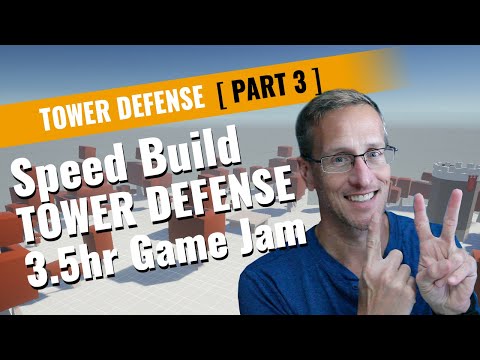
Tower Defense Jam - Part 3 - a 3.5 hour tower defense game jam - Working on an enemy

Tower Defense Jam - Part 4 - a 3.5 hour tower defense game jam - Continuing on an enemy

Tower Defense Jam - Part 1 - a 3.5 hour journey to see how far i can get by building a tower defense

Hexeye Defender - Game Jam - PostMortem

Playmaker Game Jam 2019 Submission - "GENESIS"